

Rome is not a city you arrive in quietly. From the moment you step into the city, there’s a certain rhythm you have to adjust to. Scooters move through traffic like they’ve memorized every corner, conversations spill out from cafés onto the streets, and everything feels just a little bit louder, faster, and more alive than expected. What stands out almost immediately is how natural everything feels. Nothing is presented to you like a spectacle, even though it easily could be. You turn a corner, walk down a street that feels ordinary enough, and then suddenly, history appears in front of you without warning. Not framed. Not introduced. Just there. That’s how you first come across the Colosseum.
Colosseum, Roman Forum, and Palatine Hill
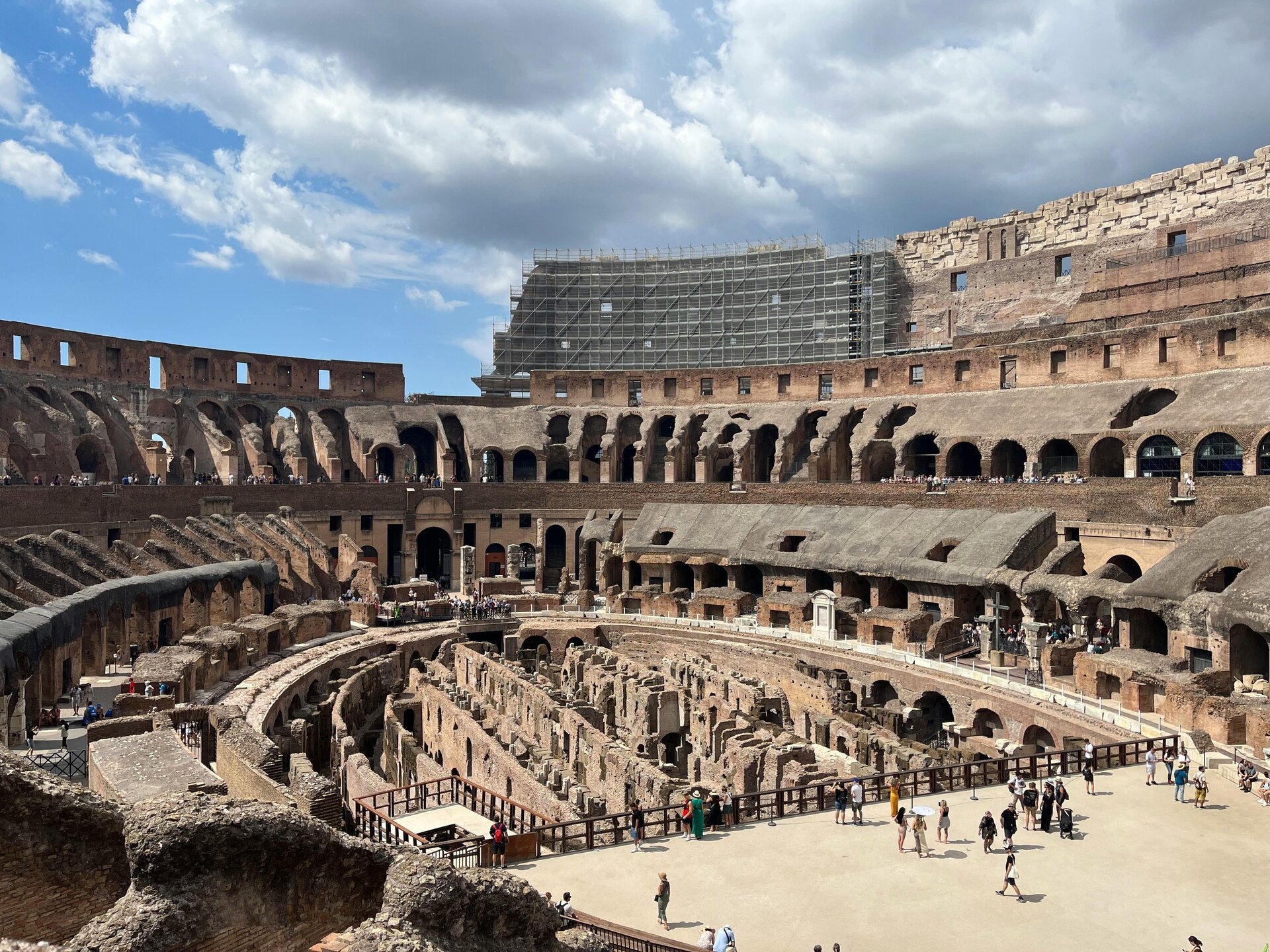


There’s no real build-up to it. One moment you’re in the middle of the city, surrounded by traffic and movement, and the next, the Colosseum is standing right in front of you, as if it has always been part of the same scene. It’s larger than expected, but what makes it interesting is not just its size. It’s the way it blends into everything around it. Cars pass by, people walk past it casually, and yet it carries a weight that immediately slows you down. Up close, the structure feels raw. The stone is worn, uneven, marked by time rather than restored to perfection. You can see where pieces have changed, where history has left its trace. It doesn’t feel distant or untouchable. It feels present. Inside, the space opens up in a way that shifts your perspective. The structure becomes clearer, almost logical. You begin to notice how everything is arranged, how it once functioned, and how much of it is still visible today. It doesn’t require much imagination. You’re standing in it, moving through it, understanding it simply by being there.
From the Colosseum, the transition into the Roman Forum feels less like entering a new place and more like continuing a story that has changed tone. The Forum is quieter, more open, and less immediate. At first, it can feel almost understated, especially after the scale of the Colosseum. But as you walk further in, the space begins to unfold in a different way. What looks like scattered ruins slowly starts to form something more complete. You begin to recognize pathways, structures, and the outline of what once was the center of daily life. This wasn’t a single landmark, but a place where everything came together. Now, it moves at a slower pace. People walk through it without rushing, voices soften, and the atmosphere shifts into something more reflective. You find yourself paying more attention without really trying to. Looking longer. Walking slower. Letting the space explain itself in its own time.
As you continue, the path gradually leads upward toward Palatine Hill, and with that change in direction comes another shift in how the city feels. The climb creates distance, not just physically, but mentally. The noise fades slightly, the movement below becomes less immediate, and by the time you reach the top, everything feels more open. There’s more space here. More greenery. A different kind of quiet.
From above, Rome doesn’t feel chaotic anymore. It feels connected. The Colosseum, the Forum, the surrounding streets, everything you’ve just walked through becomes part of a larger picture. You’re no longer inside it, you’re looking at it. It’s not a dramatic moment, and that’s exactly why it works. You pause without planning to. You look out, take it in, and for a moment, nothing feels rushed. Rome doesn’t separate its past from its present, it layers it. And walking through the Colosseum, the Roman Forum, and Palatine Hill isn’t about stepping back in time. It’s about moving through it, piece by piece, until the city starts to make sense in a way it didn’t before.
When you leave, it’s not a sudden shift. There’s no clear moment where one part of the city ends and another begins. You simply find yourself back in the streets, surrounded by the same movement, the same noise, the same rhythm as before. But it feels different now. The buildings, the streets, even the spaces between them start to carry more meaning. What once felt like just another city begins to feel layered, familiar in a way that’s hard to explain. And as you keep walking, Rome doesn’t feel like something you’re trying to figure out anymore. It feels like something you’ve started to understand.